

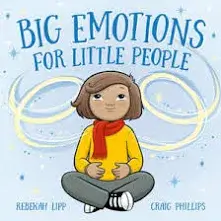
Big Emotions For Little People
Rebekah Lipp & Craig Phillips
When we help young children label their emotions, it helps them to understand and manage what they are feeling and to improve their emotional literacy as they grow.
The SWAN Resource Library is located at the SWAN Office, and contains more than 350 items. Books and DVDs are available for loan free of charge to all SWAN Members, and we have numerous FREE information pamphlets available to keep. Please contact us to enquire as to the availability of items and to borrow from our library. Resources will need to be collected from, and returned to our Busselton office, located at 12 Pettit Crescent, Busselton WA 6280.
If you have a resource you would like to share with others, please contact us to make arrangements. Alternatively, make a Donation to SWAN. All donations over $2.00 are tax deductible.
The South West Autism Network relies on the generosity of our members and community to support the families of the south west region living with ASD.
When we help young children label their emotions, it helps them to understand and manage what they are feeling and to improve their emotional literacy as they grow.
Black Duck Wisdom is the quickest and most affordable self-help book in the market today.
Simple life wisdoms for people too busy to read the big self-help books! You will be nudged about something in your life that could be changed or made better.

For primary students.
Blake’s Comprehension Guide clearly explains the range of strategies required for effective reading.

Understanding and using body language can be difficult for people with an ASD.
But learning how to use it effectively can help us to communicate more successfully and enjoyably with other people including family, friends and colleagues.

A systematic approach to teaching social interaction skills to children and adolescents with autism spectrum disorders and other social difficulties.
This comprehensive five-step model addresses the need for social programming for children and adolescents with autism spectrum disorders by helping children identify the skills they need to form relationships and an intervention plan to help them acquire these skills. Instead of offering a single strategy, this book organizes the myriad social skills strategies and resources currently available to make it easier for parents and educational professionals to teach social skills and design social skills programs for children with ASD.

Bullies are mean. Bullies are scary. Bullies are a pain in the brain-and every child needs to know what to do when confronted by one.
This book blends humor with serious, practical suggestions for coping with bullies. Trevor Romain reassures kids that they’re not alone and it’s not their fault if a bully decides to pick on them. He explains some people are bullies and describes realistic ways to become “Bully-Proof,” stop bullies from hurting others, and get help in dangerous situations. And if bullies happen to read this book, they’ll find ideas they can use to get along with others and feel good about themselves-without making other people miserable.

Most books about bullying tell children how to act without addressing how they feel - but you can't act brave and confident if you feel stressed and helpless inside.
Jenny Alexander’s approach is to develop readers’ psychological defenses. Through a mix of exercises, quizzes, and fictional scenarios, she combines common sense with simple cognitive techniques to build up children’s self-esteem. Her tone is humorous and upbeat, but always sensitive to the reader’s feelings.

Are there practical things you can do to stop being bullied - at home, at school and online? What are frenemies and how can you deal with them?
How can you learn to make friends and respect yourself? If you’re a bully, how can you change your behaviour? This essential guide will tell you what bullying is, where it happens and what you can do about it. There are tips on how to assert yourself and develop your self-esteem.

From victim to victor. From reactive to proactive. From suffering to succeeding. Martial arts master Phil Nguyen teaches the nine treasures to help children and their parents
discover their inner strength so they can deal powerfully with bullying now and face adversity confidently for the rest of their lives. By applying the powerful principles in Bully Busters and Beyond, you can help your children build the self-confidence, self-esteem, and strength of character to go beyond their bullying challenges to lead happy, healthy, and successful lives.

This book is a potpourri of stories, anecdotes, ideas, challenges, sound concepts, and effective strategies that may well revolutionise our thinking about bullying.
Bullying can be defined as a repeated, persistent, or systematic action by one or more people that violates another person’s rights to feel safe and be respected. Bullying is all about power imbalance. Bully-proofing is therefore about balancing the power.

Who has the most power to stop and prevent bullying? Teachers? Parents? The Principal of the Universe? No, no, and no way!
When it comes to changing bullying behavior, nobody has more power than bystanders – all the people who see bullying or know about it. How strong are bystanders? Stronger than a snarling seventh grader. More powerful than a petty put-down. Able to delete Internet rumors with a single click. When BYstanders choose to act as UPstanders, they are real superheroes!

Written by a teenager with dyspraxia, this is a humorous and inspiring guide for young adults with dyspraxia...
and those around them trying to get to grips with the physical, social and psychological chaos caused by developmental co-ordination disorder (DCD).Victoria Biggs explains the primary effects of dyspraxia – disorganisation, clumsiness and poor short-term memory – as well as other difficulties that dyspraxic teenagers encounter such as bullying and low self-esteem.
